


Effect Flake Sample Pack (6 Colors)
Effect Flake Sample Pack (6 Colors)
Each sample is 1 gram.
Couldn't load pickup availability
Premium effect flake pigments designed for high-impact reflective finishes in nail and creative coating systems. Built for layering in gel polish, top coats, dip powder, and decorative nail applications with stable optical performance and strong visual texture.
✔ Mica-Free
✔ Vegan / Cruelty-Free
✔ High Reflective Flake Structure
✔ UV & Solvent Stability
✔ Compatible with Gel, Dip Powder & Acrylic Systems
|
FT11301 |
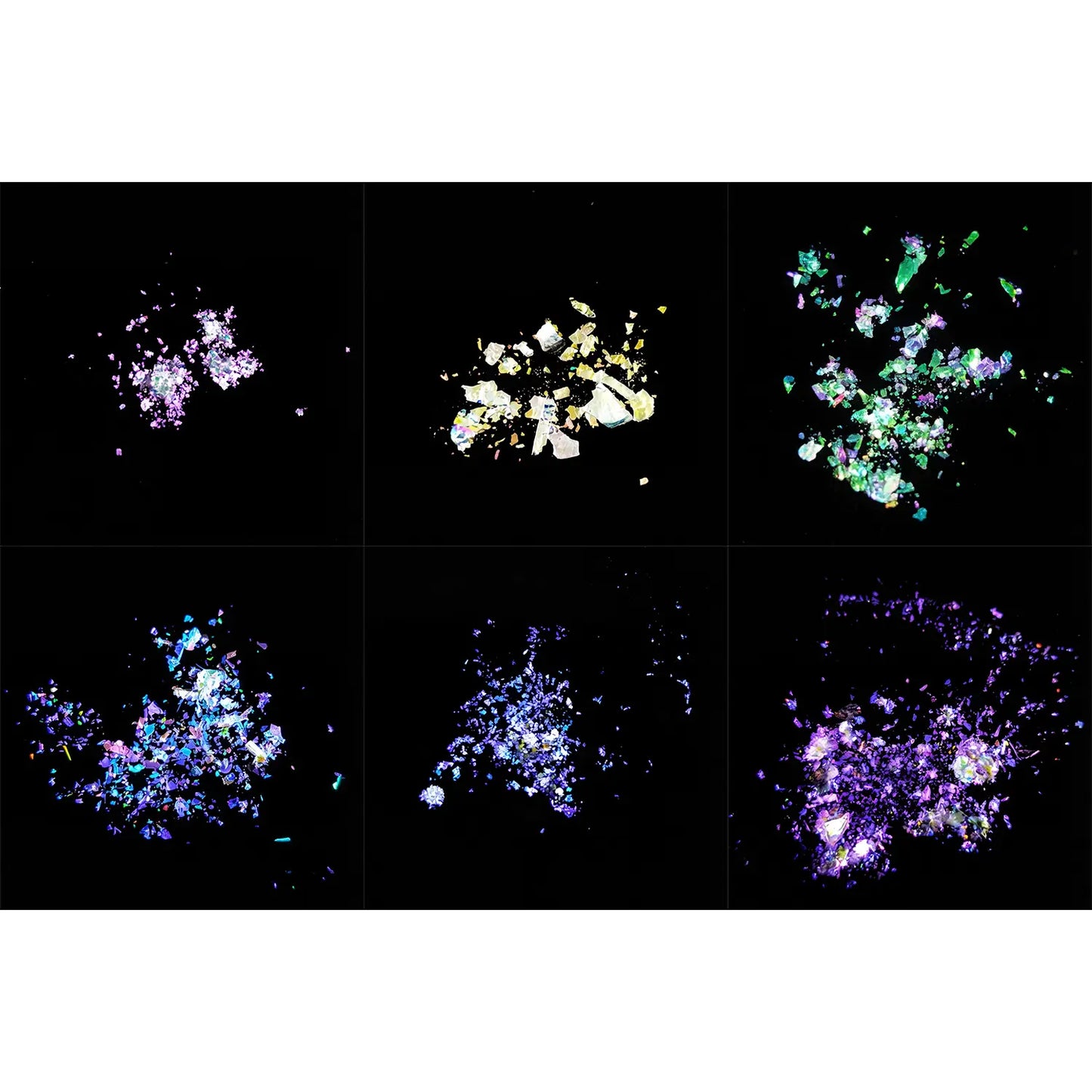
Ruby Magenta/Amber Gold |
|
FT31401 |
Amber Gold/Emerald Green |
|
FT41101 |
Emerald Green/Ruby Red |
|
FT61101 |
Sapphire Blue/Ruby Red |
|
FT61701 |
Sapphire Blue/Violet Purple |
|
FT71101 |
Violet Purple/Ruby Magenta |
Need more options? Request full catalog or get a bulk quote.
View full details
Application Chart
This is a general guideline for formulation testing; starting with low loading and small-batch trials before scale-up is recommended, and final dosage depends on binder system, substrate, and desired optical effect.
Collapsible content
Nail Art
Nail Polish: 2–20% by weight; Suitable for decorative nail polish systems using optical pigments. Higher loading increases opacity and visual effect intensity; ensure stable dispersion for uniform finish.
Gel Polish: 2–20% by weight; Suitable for gel lacquer, cat-eye, and top-coat systems. Use medium to high viscosity bases to maintain suspension stability and prevent settling.
Chrome Powders: Direct rub-on; Ultra-fine optical pigments for mirror and interference effects. Apply over cured no-wipe gel; performance depends on surface smoothness and base color.
Dip Powders: 5–20% by weight; Pre-mixed optical pigment systems for dip nail applications using resin + powder layering. Adjust loading to balance color intensity and coating thickness.
Acrylic Powders: 0.5–2% by weight; Low-loading optical pigments for acrylic sculpting systems. Designed to preserve mechanical strength while adding subtle visual effects in overlays and extensions.
Cosmetics
Eyeshadow: 10–80% by weight; Suitable for high-impact color and optical effects. Adjust loading according to desired opacity, shimmer intensity, and base formulation. Ensure uniform dispersion for consistent color payoff.
Lipstick & Lip Gloss: 5–10% by weight;
Suitable for shimmer and color-enhancing lip products. Compatible with wax/oil-based systems when properly dispersed. Conduct compatibility testing with the complete formulation.
Blusher, Foundation & CC Cream: 2–10% by weight; Used for subtle optical enhancement, glow effects, and color refinement. Lower loading levels are typically recommended for natural makeup finishes.
Makeup Powder & Face Color Products: 5–10% by weight; Suitable for pressed powders, loose powders, and decorative makeup formulations. Optimize particle distribution to achieve smooth application and uniform appearance
Eyebrow Pencil & Eyeshadow Pen: 2–15% by weight; Suitable for pencil and stick-type cosmetic systems. Requires good pigment wetting and dispersion for consistent visual effects.
Face Cream, Cold Cream & Body Cream: 1–5% by weight; Suitable for cream-based cosmetic products requiring subtle pearlescent or optical effects. Stability depends on emulsion structure and particle suspension.
Body Lotion: 1–5% by weight; Used for decorative shimmer and visual enhancement in lotion systems. Maintain stable suspension during storage.
Shampoo & Hair Care Products: 0.1–2% by weight; Used for low-level shimmer effects in rinse-off products. Requires proper suspension control to minimize settling.
Hair Spray & Fragrance Products: 0.1–10% by weight; Applicable for visual enhancement where suspended optical effects are desired. Evaluate transparency, stability, and spray system compatibility.
Soap (Melt & Pour / Glycerin Soap): 1–5% by weight; Suitable for decorative optical effects in solid soap systems. Maintain uniform dispersion during cooling and solidification.
Automotive Coatings
Peelable Automotive Coatings: 20–50 g per gallon; Compatible with removable coating systems (Plasti Dip, HaloEFX, Autoflex, etc.). Optical pigments can be incorporated into base or clear layers; dark substrates enhance depth and color travel effects.
Standard Automotive Clears; 10–25 g per gallon; Suitable for basecoat, mid-coat, and clearcoat systems. Optical effect strength depends onlayer thickness and base color; ensure thorough dispersion for uniform appearance.
Resin Art & Acrylic Pouring
Epoxy Resin Casting: 0.2–1% by weight; Suitable for coasters, jewelry, molds, and deep-pour casting systems using optical pigments. Transparent resin systems enhance color travel and depth; ensure thorough mixing to avoid settling during curing.
Acrylic Pouring: 0.5–3% by weight; Suitable for fluid art, canvas pouring, and abstract decorative finishes. Fine particle optical pigments improve flow behavior and visual separation; dark backgrounds enhance color travel effects.
Industrial, Plastics & Glass
Masterbatch: 10–30% by weight; Suitable for concentrated color masterbatch systems and compound production. Requires uniform dispersion during extrusion; final loading depends on resin system and target optical effect.
Plastic Resins: 0.2–0.5% by weight; Suitable for injection molding, casting, and engineering plastic systems. Low loading is typically sufficient for optical effect development; heat stability should be validated before production.
Plastic Films: 5–10% by weight; Suitable for decorative films, vinyl wraps, and flexible plastic systems. Works best in thin-film applications with controlled dispersion; particle size directly affects surface smoothness.
Plastic Bottles: 1–2% by weight; Suitable for transparent and colored bottle systems. Low loading maintains clarity while introducing optical effects; compatibility with base resin should be tested prior to scale-up.
Glass: 1–10% by weight; Suitable for decorative glass and specialty coating systems. Transparent substrates enhance reflectivity and color travel effects; adhesion and curing compatibility should be verified.
Printing & Inks
Flexographic Inks: 15–25% by weight; Suitable for packaging films, labels, and flexible substrates. Fine particle optical pigments are recommended for stable print consistency and uniform color development.
Offset Printing Ink: 5–10% by weight: Suitable for paper-based decorative and specialty printing applications. Lower loading maintains ink flow and printability; compatibility with binder systems should be validated.
Screen Printing Inks: 10–30% by weight; Suitable for graphics, textiles, and specialty decorative prints. Particle size should match mesh count to ensure stable transfer and uniform optical effect.
Textile Printing Inks & Pastes: 5–10% by weight; Suitable for fabric printing and fashion applications. Requires stable dispersion systems and should be tested for wash durability and binder compatibility.
Gravure Inks: 5–15% by weight; Suitable for high-quality packaging, labels, and decorative film printing. Fine optical pigments improve flow behavior and print uniformity; monitor stability during long production runs.