


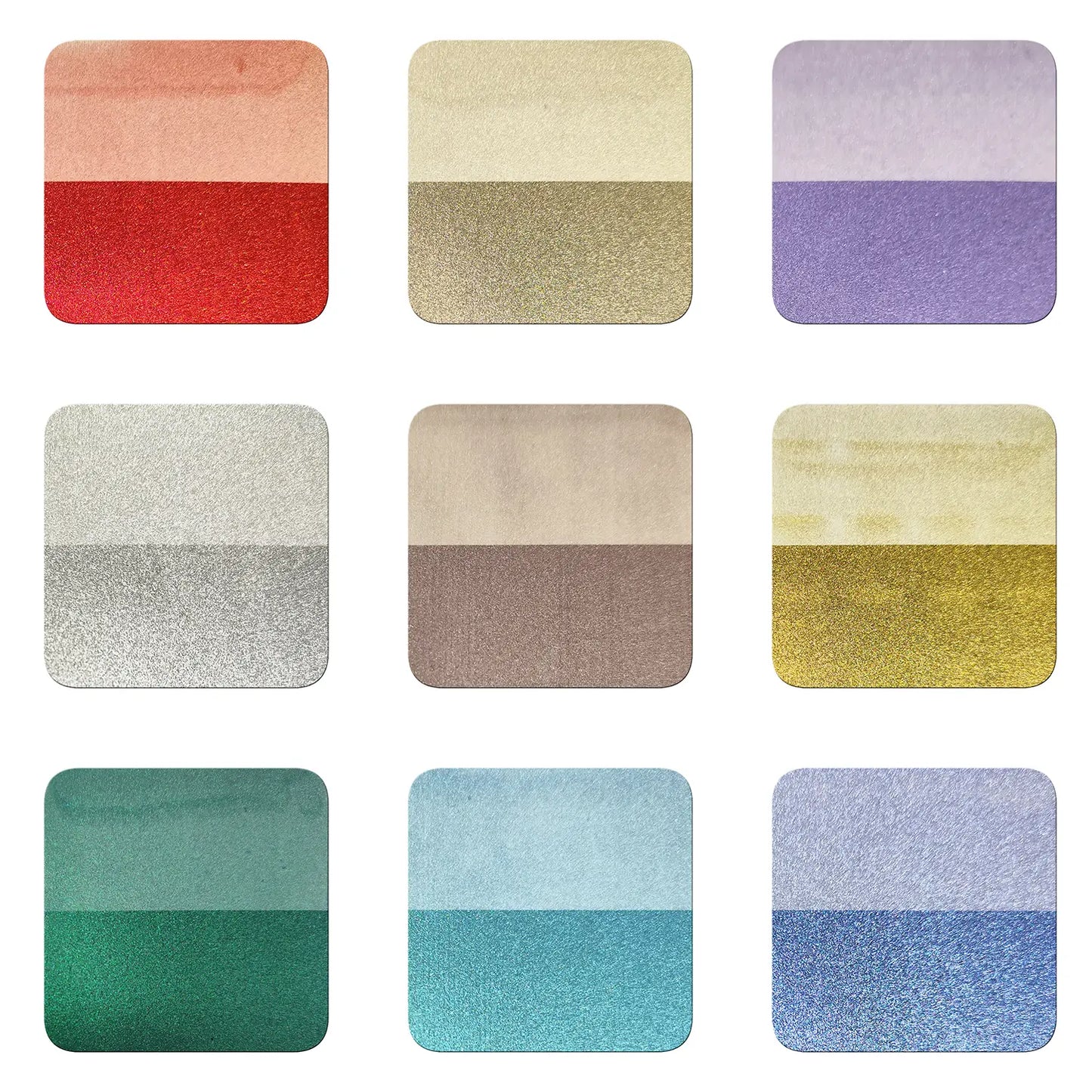
Magnetic Pigment Sample Pack (9 Colors)
Magnetic Pigment Sample Pack (9 Colors)
Each sample is 1 gram.
Couldn't load pickup availability
Premium Magnetic Pigments engineered through thin-film microstructure for dynamic cat-eye effects and strong light-reflective depth. Designed for nail brands, formulators, and beauty professionals evaluating advanced magnetic effect pigments.
✔ Mica-Free
✔ Vegan / Cruelty-Free
✔ Strong Magnetic Response
✔ High Reflective Depth
✔ Chrome & Color Travel System
|
MP10101 |
Ruby Flame |
|
MP30101 |
Ochre Gold |
|
MP70101 |
Violet Dusk |
|
MP80201 |
Arctic Silver |
|
MT11301 |
Pink Bloom/Lemon Glow |
|
MT31401 |
Ochre Yellow/Moss Green |
| MT42501 | Bright Green/Aqua Stream |
|
MT51601 |
Aqua Flow/Deep Ocean |
|
MT61701 |
Blue Drift/Violet Mist |
Need more options? Request full catalog or get a bulk quote.
View full details

Application Chart
This is a general guideline for formulation testing; starting with low loading and small-batch trials before scale-up is recommended, and final dosage depends on binder system, substrate, and desired optical effect.
Collapsible content
Nail Art
Nail Polish: 2–20% by weight; Suitable for decorative nail polish systems using optical pigments. Higher loading increases opacity and visual effect intensity; ensure stable dispersion for uniform finish.
Gel Polish: 2–20% by weight; Suitable for gel lacquer, cat-eye, and top-coat systems. Use medium to high viscosity bases to maintain suspension stability and prevent settling.
Chrome Powders: Direct rub-on; Ultra-fine optical pigments for mirror and interference effects. Apply over cured no-wipe gel; performance depends on surface smoothness and base color.
Dip Powders: 5–20% by weight; Pre-mixed optical pigment systems for dip nail applications using resin + powder layering. Adjust loading to balance color intensity and coating thickness.
Acrylic Powders: 0.5–2% by weight; Low-loading optical pigments for acrylic sculpting systems. Designed to preserve mechanical strength while adding subtle visual effects in overlays and extensions.
Cosmetics
Eyeshadow: 10–80% by weight; Suitable for high-impact color and optical effects. Adjust loading according to desired opacity, shimmer intensity, and base formulation. Ensure uniform dispersion for consistent color payoff.
Lipstick & Lip Gloss: 5–10% by weight;
Suitable for shimmer and color-enhancing lip products. Compatible with wax/oil-based systems when properly dispersed. Conduct compatibility testing with the complete formulation.
Blusher, Foundation & CC Cream: 2–10% by weight; Used for subtle optical enhancement, glow effects, and color refinement. Lower loading levels are typically recommended for natural makeup finishes.
Makeup Powder & Face Color Products: 5–10% by weight; Suitable for pressed powders, loose powders, and decorative makeup formulations. Optimize particle distribution to achieve smooth application and uniform appearance
Eyebrow Pencil & Eyeshadow Pen: 2–15% by weight; Suitable for pencil and stick-type cosmetic systems. Requires good pigment wetting and dispersion for consistent visual effects.
Face Cream, Cold Cream & Body Cream: 1–5% by weight; Suitable for cream-based cosmetic products requiring subtle pearlescent or optical effects. Stability depends on emulsion structure and particle suspension.
Body Lotion: 1–5% by weight; Used for decorative shimmer and visual enhancement in lotion systems. Maintain stable suspension during storage.
Shampoo & Hair Care Products: 0.1–2% by weight; Used for low-level shimmer effects in rinse-off products. Requires proper suspension control to minimize settling.
Hair Spray & Fragrance Products: 0.1–10% by weight; Applicable for visual enhancement where suspended optical effects are desired. Evaluate transparency, stability, and spray system compatibility.
Soap (Melt & Pour / Glycerin Soap): 1–5% by weight; Suitable for decorative optical effects in solid soap systems. Maintain uniform dispersion during cooling and solidification.
Automotive Coatings
Peelable Automotive Coatings: 20–50 g per gallon; Compatible with removable coating systems (Plasti Dip, HaloEFX, Autoflex, etc.). Optical pigments can be incorporated into base or clear layers; dark substrates enhance depth and color travel effects.
Standard Automotive Clears; 10–25 g per gallon; Suitable for basecoat, mid-coat, and clearcoat systems. Optical effect strength depends onlayer thickness and base color; ensure thorough dispersion for uniform appearance.
Resin Art & Acrylic Pouring
Epoxy Resin Casting: 0.2–1% by weight; Suitable for coasters, jewelry, molds, and deep-pour casting systems using optical pigments. Transparent resin systems enhance color travel and depth; ensure thorough mixing to avoid settling during curing.
Acrylic Pouring: 0.5–3% by weight; Suitable for fluid art, canvas pouring, and abstract decorative finishes. Fine particle optical pigments improve flow behavior and visual separation; dark backgrounds enhance color travel effects.
Industrial, Plastics & Glass
Masterbatch: 10–30% by weight; Suitable for concentrated color masterbatch systems and compound production. Requires uniform dispersion during extrusion; final loading depends on resin system and target optical effect.
Plastic Resins: 0.2–0.5% by weight; Suitable for injection molding, casting, and engineering plastic systems. Low loading is typically sufficient for optical effect development; heat stability should be validated before production.
Plastic Films: 5–10% by weight; Suitable for decorative films, vinyl wraps, and flexible plastic systems. Works best in thin-film applications with controlled dispersion; particle size directly affects surface smoothness.
Plastic Bottles: 1–2% by weight; Suitable for transparent and colored bottle systems. Low loading maintains clarity while introducing optical effects; compatibility with base resin should be tested prior to scale-up.
Glass: 1–10% by weight; Suitable for decorative glass and specialty coating systems. Transparent substrates enhance reflectivity and color travel effects; adhesion and curing compatibility should be verified.
Printing & Inks
Flexographic Inks: 15–25% by weight; Suitable for packaging films, labels, and flexible substrates. Fine particle optical pigments are recommended for stable print consistency and uniform color development.
Offset Printing Ink: 5–10% by weight: Suitable for paper-based decorative and specialty printing applications. Lower loading maintains ink flow and printability; compatibility with binder systems should be validated.
Screen Printing Inks: 10–30% by weight; Suitable for graphics, textiles, and specialty decorative prints. Particle size should match mesh count to ensure stable transfer and uniform optical effect.
Textile Printing Inks & Pastes: 5–10% by weight; Suitable for fabric printing and fashion applications. Requires stable dispersion systems and should be tested for wash durability and binder compatibility.
Gravure Inks: 5–15% by weight; Suitable for high-quality packaging, labels, and decorative film printing. Fine optical pigments improve flow behavior and print uniformity; monitor stability during long production runs.